Tuesday, 30 July 2013

CSM James Coudy McIlwaine 12th Battalion Royal Irish Rifles.


NAME; McIlwaine, James Coudy
RANK; Company Sergeant Major
SERV. NO;
UNIT/SERVICE; 12th Battalion
REGIMENT; Royal Irish Rifles
BORN; Belfast 30th July 1891
LIVED; North Street, Carrickfergus
ENLISTED; Coleraine, 16th September 1914 aged 21
FATE; Taken prisoner of war at the Somme in July 1916, action through the war
CEMETERY; N/A
CHURCH; Joymount Presbyterian
MEMORIAL; N/A
REMARKS; James was the son of James Snr and Annie McIlwaine and brother to John and Gilbert who also served with the 12th Battalion.  In 1901 the family are recorded as living in house 123, West Division, Carrickfergus, Co. Antrim.    On 5th December 1907 McIlwaine joined Northern Bank at Head Office and from then until 1913 he worked in various bank locations in Belfast and Coleraine.  By 1911, the family have moved to 8 North Street in Carrickfergus where James is recorded as a Bank Official.  On ‘Ulster Day’, Saturday, 28th September 1912, McIlwaine signed the Ulster Covenant at Carrickfergus Court House.   Whilst working in Coleraine James volunteered and enlisted on 16th September 1914 with the 12th Battalion Rifles.  He joined the British Expeditionary Force and was promoted first to Lance Corporal and then to Corporal.  Service was seen in the Somme 1916 (where he was taken prisoner), Messines 1917, Ypres 1917 (Langemarck), St. Quentin 1918, Mesines 1918 (Kemmel) and then the Allied Advance 1918.   Demobilisation came in February 1918.  He was awarded the 1914/15 Star, the British Victory Medal and the British War Medal.  After the war James went back to work with the Northern Bank for many years were he eventually reached the position of Assitant Chief Cashier in head office.  (Thanks go to the Northern Bank Roll of Honour for much of this detailed information) - http://northernbankwarmemorials.blogspot.co.uk/2013/01/mcilwaine-james-coudy.html


Monday, 29 July 2013

Trumpeter J.D. Gray - Royal Garrison Artillery


NAME; Gray, J.D
RANK; Trumpeter
SERV. NO; 8279
UNIT/SERVICE; 13th Siege Battery (formerly Antrim Artillery Band)
REGIMENT; Royal Garrison Artillery
BORN;
LIVED;
ENLISTED;
FATE; Killed in Action – 28th July 1917 aged 32
CEMETERY; Dickebusch New Military Cemetery Extension – II. E. 13
CHURCH;
MEMORIAL;
REMARKS; Son of Charles and Margaret Gray of Montrose, husband of Ethel Gray of 47 Bents Road, Montrose.


Sergeant Hugh Morrison Feeney 9th Batt. New Zealand Mounted Rifles.


NAME; Feeney, Hugh Morrison
RANK; Sergeant
SERV. NO; 11/669
UNIT/SERVICE; NZEF, New Zealand Mounted Rifles Brigade
REGIMENT; Wellington Mounted Rifles, 9th Battalion Wellington East Coast Sqd
BORN; Carrickfergus in 1882
LIVED; Castle Street, Carrickfergus / Wellington, New Zealand
ENLISTED; Eketahuna, New Zealand August 1914
FATE; Died of Wounds - Killed in action 27th July 1915 aged 33
CEMETERY; East Mudros Military Cemetery – (Greece) – II B. 32
CHURCH; Presbyterian
MEMORIAL; Auckland War Memorial Cenotaph

REMARKS; Hugh Morrison Feeney was born in Castle Street, Carrickfergus in 1882.  He was the son of Thomas Gorman and Mary M Feeney and brother to Mary H, Tho V and Samuel Feeney.  High left Ireland in his twenties and travelled to New Zealand presumably seeking employment.  When the war came in August 1914 he enlisted in Eketahuna, New Zealand as a trooper with the 9th Battalion WEC, Wellington Mounted Rifles, NZEF.  Following short training in Wellington his division embarked from there on 16th October 1914 on board ‘Orari’ transport ship.  The NZEF arrived finally arrived in Suez, Egypt on 30th November 1914 – following an extended period of training and preparation here Hugh is promoted to the rank of Sergeant.  In May 1915 the Mounted Rifles are sent to Gallipoli as infantry where they and with the other ANZAC suffered horrendous loses in fighting there against the Turkish forces in the subsequent months.  Hugh was severely injured in fighting at Gallipoli in July 1915 and subsequently died of his wounds at sea from that place on 27th July 1915 aged 33.  He is buried at East Mudros Military Cemetery in Greece.  

Sergeant Feeney's Grave Stone in Greece


The Wellington Mounted Rifles Regiment (WMR) was one of four mounted rifles regiments raised to serve overseas in the New Zealand Expeditionary Force (NZEF) during the First World War. The WMR was part of the New Zealand Mounted Rifles Brigade and left New Zealand with the Main Body of the NZEF in October 1914.

Cap Badge of the 9th Battalion WMR


After training in Egypt the WMR fought in the Gallipoli campaign from May to December 1915. On its return from Gallipoli the regiment spent another four months in Egypt before taking part in the Sinai campaign of 1916 and the Palestine campaign of 1917–18. After the armistice with the Ottoman Turks in October 1918 the WMR remained in Palestine until March 1919, when it was sent back to Egypt to help suppress nationalist riots. The regiment disbanded in June, when most of its officers and men embarked on the troop transport Ulimaroa for the return voyage to New Zealand.

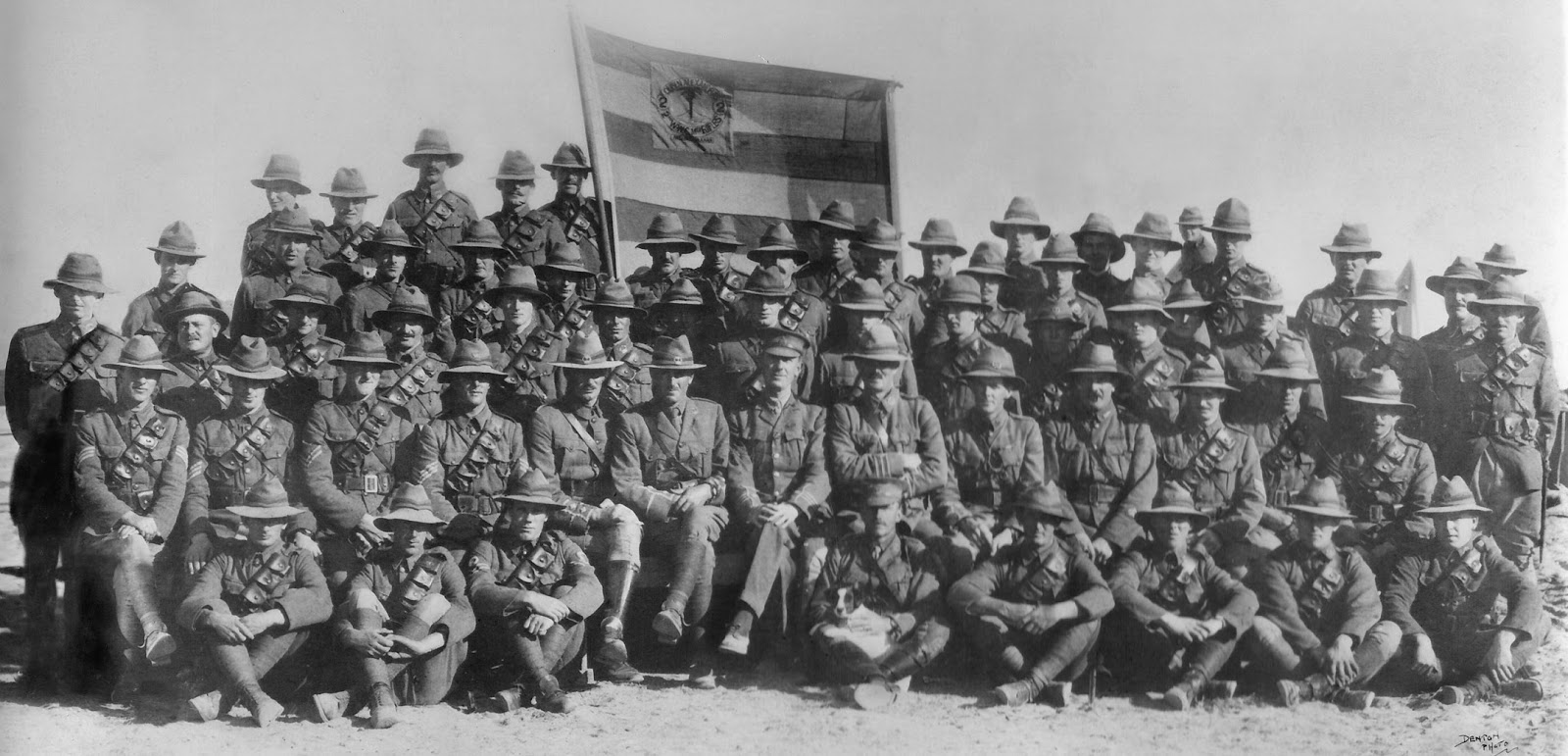
Men of the NZ Mounted Rifles Brigade in Egypt 1915


Thursday, 25 July 2013

Rifleman Robert Kirk 1st Battalion Royal Irish Rifles - Killed in Action 14th October 1914

NAME; Kirk, Robert
RANK; Rifleman
SERV. NO; 6103
UNIT/SERVICE; 1st Batt
REGIMENT; Royal Irish Rifles
BORN; Carrickfergus in 1900
LIVED; Davy’s Street, Carrickfergus
ENLISTED;
FATE; Killed in Action, October 14th 1918
CEMETERY; Dadizeele New British Cemetery (Belgium) - II. A. 2.
CHURCH; St Nicholas, COI, Carrickfergus
MEMORIAL; St Nicholas, COI
REMARKS; Robert (Bobby) was the youngest son of Thomas and Margaret Kirk of Davy's Street, Carrickfergus and brother of Francis (killed in action 1st July 1916 at the Somme), Neillie, Jane and Lucy.  He was born in Carrickfergus in 1900 and left school at 14 to take a job in the local mill.  He enlisted with the 1st Battalion Royal Irish Rifles in 1917 aged on 17.  By this stage of the war the true horrors and huge lose of life were apparent to all but men like Bobby continued to enlist to fight for King and Country.  Imagine the emotion of his parents as their second son went off to fight just a year after their other son had been killed in action.  After a short time training Bobby was sent to the Western Front were he served with distinction in France and Belgium.  He was killed in action, Belgium October 14th 1918 during the last major German offensive, less than 1 month before the end of the war.  He is buried in Dadizeele New British Cemetery in Belgium. 


 Dadizeele New British Cemetery is located 10 km east of Ypres - The village of Dadizeele was in German hands for much of the War until reached by the 36th (Ulster) Division, and taken by the 9th (Scottish) Division, on 29 September 1918. Severe fighting followed on 1 October, at Hill 41, a little south of the village.  Dadizeele New British Cemetery is in fact an extension of the communal cemetery. It was made after the Armistice when graves were brought in from other burial grounds and from the battlefields of 1918.  Bobby has originally been buried in Railway Crossing Cemetery, Dadizeele, on the Dadizeelehoek Klephoek road, 100 metres west of "Teofani" railway crossing Kirton Farm but was brought along with other men from the 36th Division who fell on the 14th October 1918. 
 

Rifleman Charles Thomas 12th Battalion Royal Irish Rifles - Davy' s Street, Carrickfergus

Remembering today:  Rifleman Charles Thomas - Service Number 524 - 12th Battalion Royal Irish Rifles.  Born in Carrickfergus in 1895, he was the son of Charles and Annie Thomas of Davy's Street Carrickfergus and the brother of Mary (Sailor's Row, Carrickfergus), Georgina, James and Joseph Thomas.  The entire family were members of the local Church of Ireland congregation at St Nicholas. 

Charles enlisted with the 12th Battalion in Belfast in 1915 and served across the West Front being first wounded in France in 1916.  He was taken prisoner of war in 1918 after being wounded in action and subsequent died of his wounds in German captivity on 25th July 1918 aged 23.  He is buried in Berlin South Western Commonwealth Cemetery. 

In 1922-23 it was decided that the graves of Commonwealth servicemen who had died all over Germany should be brought together into four permanent cemeteries. Berlin South-Western was one of those chosen and in 1924-25, graves were brought into the cemetery from 146 burial grounds in eastern Germany. There are now 1,176 First World War servicemen buried or commemorated in the Commonwealth plot at Berlin South-Western Cemetery.

Berlin South Western Cemetery


Tuesday, 23 July 2013

Sergeant Robert Houston, Military Medal - Royal Irish Rifles


Sergeant Robert Houston was born in Carrickfergus in 1892, son of Ellen and Robert Houston of Joymount Bank in the town. By 1915 he was married with one child and living in Factory Row, Woodburn.

He enlisted with the 12th Battalion Royal Irish Rifles in 1915 and was promoted to the rank of Sergeant. During fighting at the front he was awarded the Military Medal for gallantry and devotion to duty. A captain wrote that when the officer on duty had been wounded Sergt Houston took charge and got the whole situation well in hand. He was making arrangements to watch the gap caused by the blowing in of the trench and was most efficient and dependable. The report also noted that the gallant N.C.O also saved the lives of 5 men under heavy shell fire. Given his levels of commitment and bravery it is hardly surprising Robert was twice wounded during the fighting.

He survived the war but unfortunately I know little or nothing about his post war life.


Tuesday, 16 July 2013

Lieutenant Henry Neville Chamberlain - H.M.S Anchusa


NAME; Chamberlain, Henry Neville
RANK; Lieutenant
SERV. NO;
UNIT/SERVICE; Royal Naval Reserve
REGIMENT; H.M.S Anchusa
BORN; Carrickfergus 1887                   
LIVED; Carrickfergus
ENLISTED;
FATE; Died 16/07/1918 aged 31
CEMETERY; Body Never Recovered
CHURCH;  Church of Ireland
MEMORIAL; Plymouth Naval Memorial  – Panel 29
REMARKS; Son of Dilliana Mary Chamberlain and Reverend George Chamberlain and brother of Dilliana, Alice, Sarah, William, Arthur, Ralph, Richard and George Chamberlain. Henry was born in Carrickfergus in 1887 where his family loved for a number of years through his early and teenage years.  He was a former pupil of RBAI (Inst school Belfast).  In the 1901 Ireland census Henry and his family along with 2 female servants are listed as living in a house 21 North East Division of Carrickfergus Rural.  With his father being a Church of Ireland minister the family had moved around Ireland significantly; Henry's parents were born in Co. Limerick, 5 of the children we born in Co. Antrim, 2 in Co. Down and 1 in the City of Dublin.  Henry was lost at sea on board mine-sweeper HMS Anchusa after it was torpedoed off the North Coast of Ireland by the German submarine U-54was sunk by U-54 on 16th July 1918. Henry's body was never recovered and he is remembered on the Plymouth Naval Memorial.  


Lieutenant Henry Neville Chamberlain

Henry's name on the Plymouth Naval Memorial